Well, I have removed almost all the layers of fabric that I can, and was expecting this to be the last post about the quilt, but it isn't to be. It has revealed a lot of information, but posed almost as many questions!
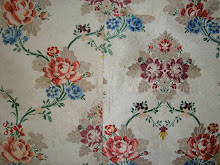
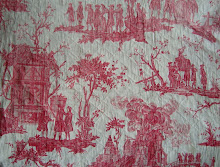
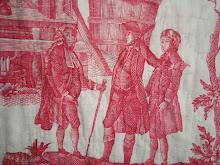
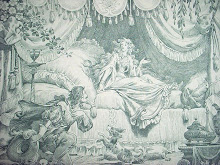
I was expecting a single mass of sheeps fleece wadding, but it turns out to be a patchwork of pieces, almost completely felted over time, pieced together into a small rectangle with linen or hemp thread. Most of the panels are edged with the remains of the indigo woven fabric discovered in part 4, which now turns out to be a colourful indigo, white, pink, yellow and maybe purple ikat woven flamme fabric, either cotton or linen, I'm not too sure. This could be quite an early fabric! If you click on each photo for the supersized pics, you may be able to see that it looks as if the ikat remains - a real shame so little remains - seem to be over-lapping the red and blue striped fabric at their edges where front and back have been sewn together, leading me to believe that this must surely be the earliest layer, with the ikat as the next layer, followed by the R&S, then the C&J. I am now of the opinion that the red and black printed floral twil was the reverese for the R&S, but outlasted the rest of the layers beacuse of its durability as a fabric. Please see the way some of the colour has bled from into the fleece from the stitchmarks, directly onto the fleece. The greenish grey floral was the penultimate layer, finally to be patched with the scruffy, faded cream cretonne.
A lot of food for thought there, 2 ideas spring to mind at this stage, please let me know what you think, and your ideas about its story!
Firstly, it could be a quilt that has been passed on through the same family as an heirloom, being re-worked and re-covered by different generations. Perhaps it started its journey in the late 1700s, early 1800s as evidenced by the woven fabrics in the centre. This would have been in use for quite some time, then, when the ikat had virtually worn away, was discarded, and eventually salvaged by being cut into panels and re-covered with 'modern, fashionable' printed cotton (R&S) on 1 side, with the heavy twill weave print for the other side sometime around the mid 1800s. A bit later, maybe around 1860-80, it was re-covered in the second printed cotton, the C&J layer, but the twill was still in good enough condition to stay in place. When the C&J wore out, the greenish grey floral was added around 1890-1900. Finally, the scruffy cream panel was applied over the worn floral as a large patch around 1920-30.
Secondly, following a similar timeline, it could have been made by a reasonably well-off woman, a Farmer's wife, for example, as a large quilt and used until the fabric wore out, then gifted to a poorer relative, or perhaps a servant, who cut it down into useable panels, sewed them into a small quilt shape and recovered it. It was then kept and rennovated, until it was eventually discarded and ended up in the abondoned rag store in the 1950s, which is where it was discovered by the woman I bought it from.
Of course, these are just theories and ideas, but the 'story' of this little quilt begs to told in some way. We shall never really know, but it is fun to try to 'deduce' a cultural context for it!
Now that I have removed most of the fabric, a few last things need to be looked at for the next post, I need to strip out some of the red & blue woven stripe, and see if it is the central, or earliest layer, and I shall try out a burn test on the woven striped pabrics to try to ascertain what type of fabric they are made from, wool, cotton, linen etc. Your comments and ideas would be greatly appreciated!
PS. I have just looked this post to check spelling etc, and noticed something I hadn't spotted before when i checked the photos. Please look at the second to last supersize pic, does it look to you as if there is a piece of different woven fabric UNDERNEATH the red & blue layer, I had assumed the R&B to be the earliest, maybe it isn't! I shall have to investigate...